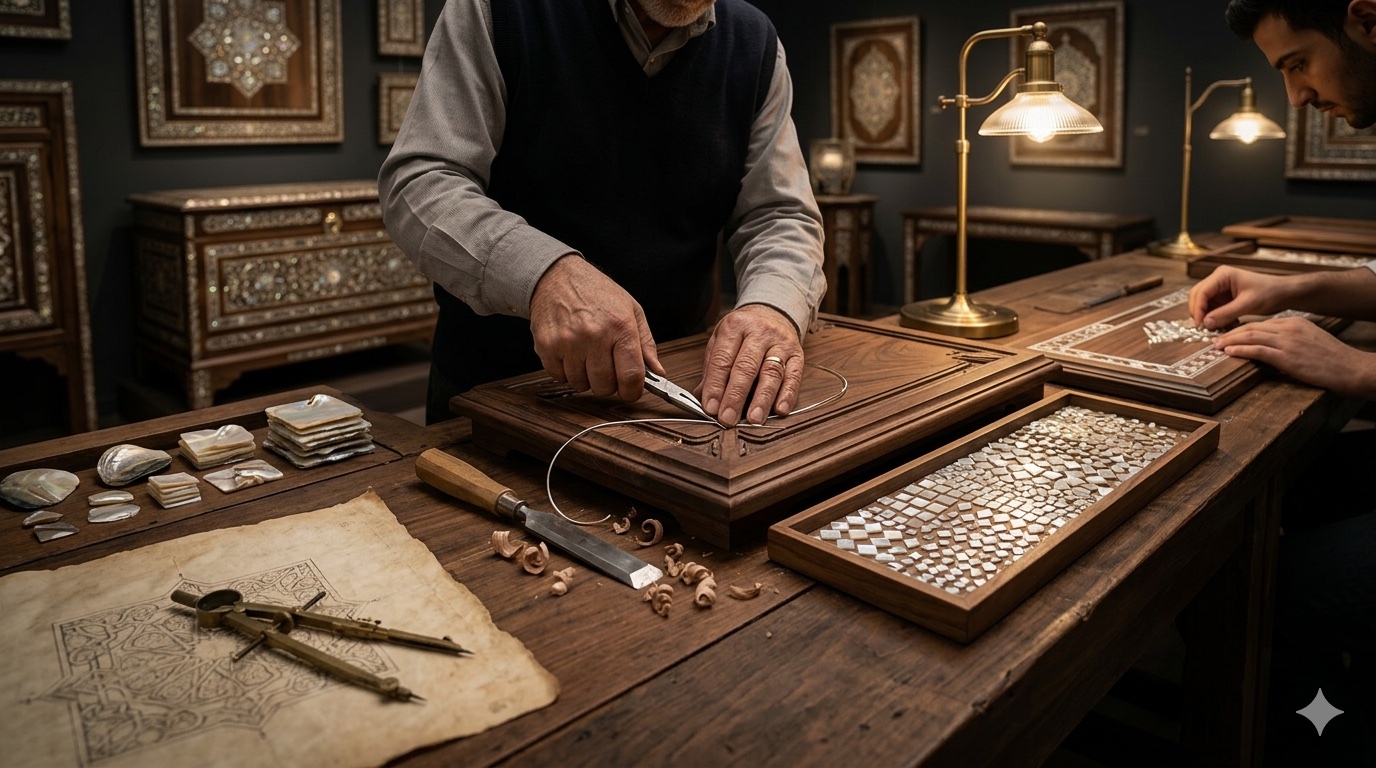
Craftsmanship
Understanding the extraordinary skill, patience, and devotion that transforms raw materials into objects of enduring beauty.
“The true value of a handmade object lies not only in the beauty of the finished piece, but in the centuries of knowledge embodied in every cut, every join, every polished surface.”
Design & Drawing
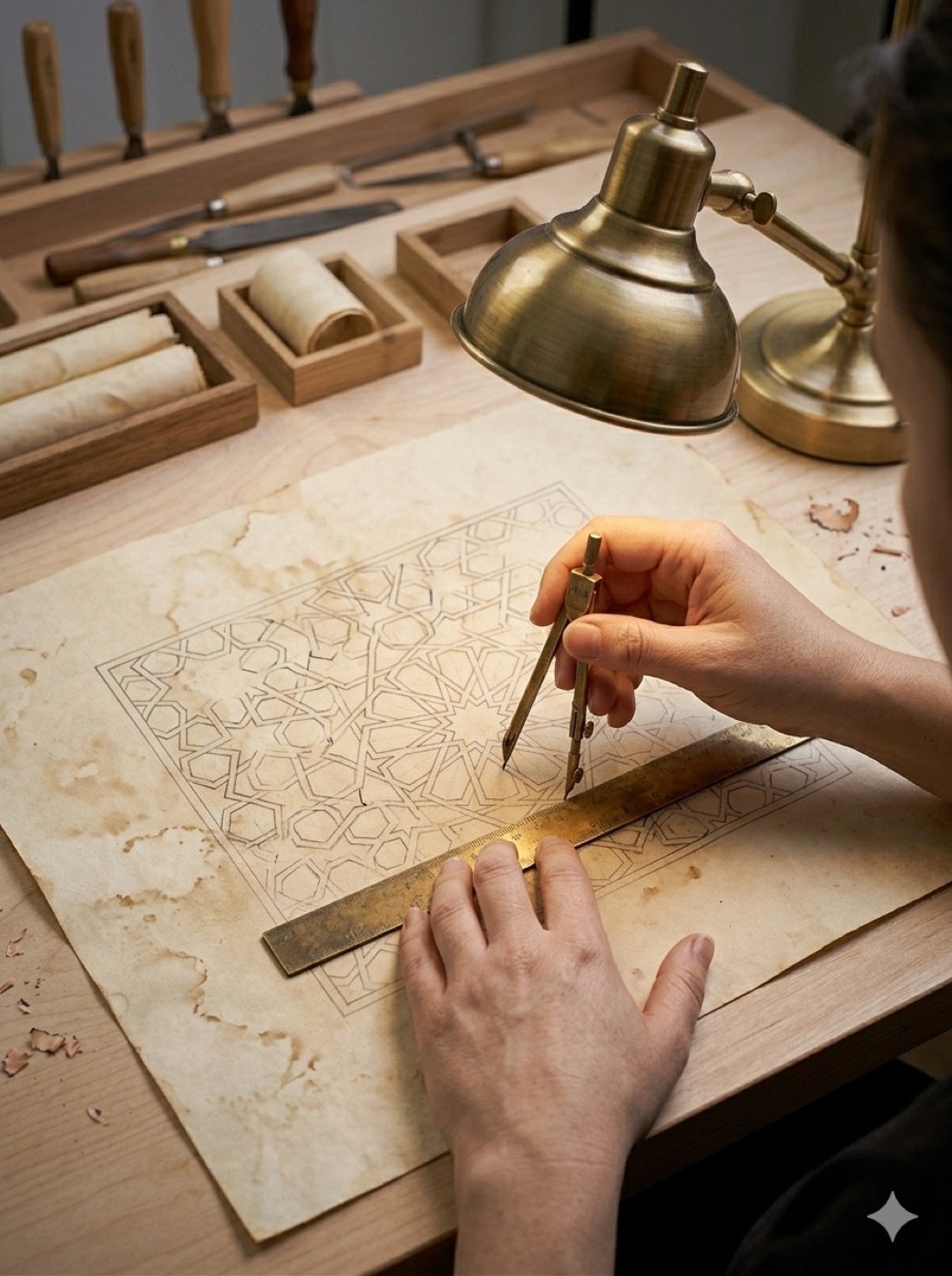
Every piece begins with a master drawing — the rasmi. Using brass compasses, straight-edges, and centuries-old mathematical principles, the artisan composes the intricate geometric pattern on paper that will guide every cut, every channel, every placement that follows.
The designs draw on the rich vocabulary of Islamic geometric art — six-, eight-, and twelve-pointed star polygons, arabesques, and interlacing forms — refined across more than a thousand years of Levantine and wider Islamic tradition.
Wood Preparation
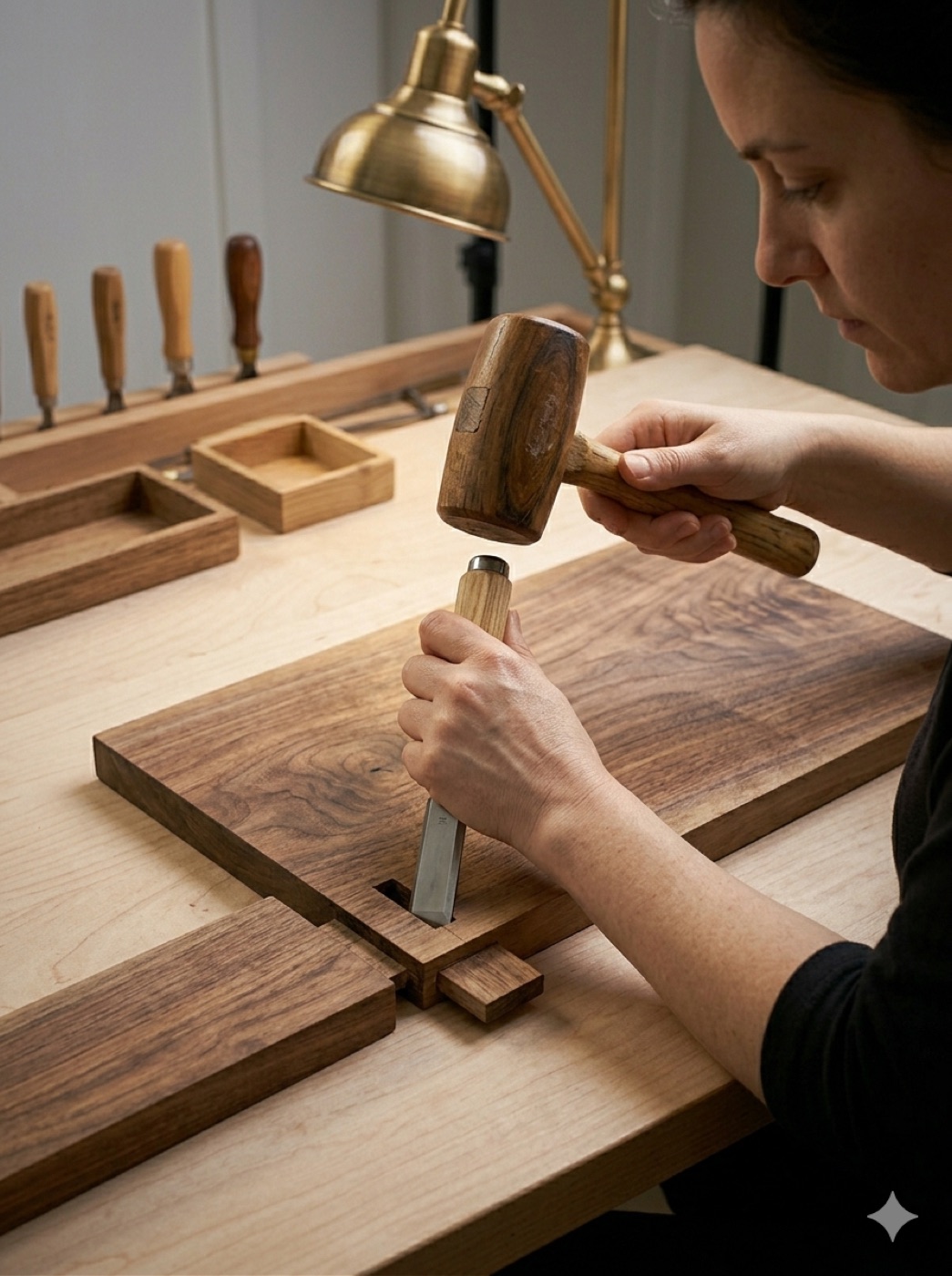
Only properly aged walnut is selected for its grain, density, and stability. The wood is seasoned naturally over years, then shaped and joined using traditional mortise-and-tenon joinery — no nails, no screws.
Stability is everything. The substrate must hold thousands of tiny inlay pieces securely for centuries, while remaining workable enough to take the razor-thin channels that will receive them.
Shell Cutting
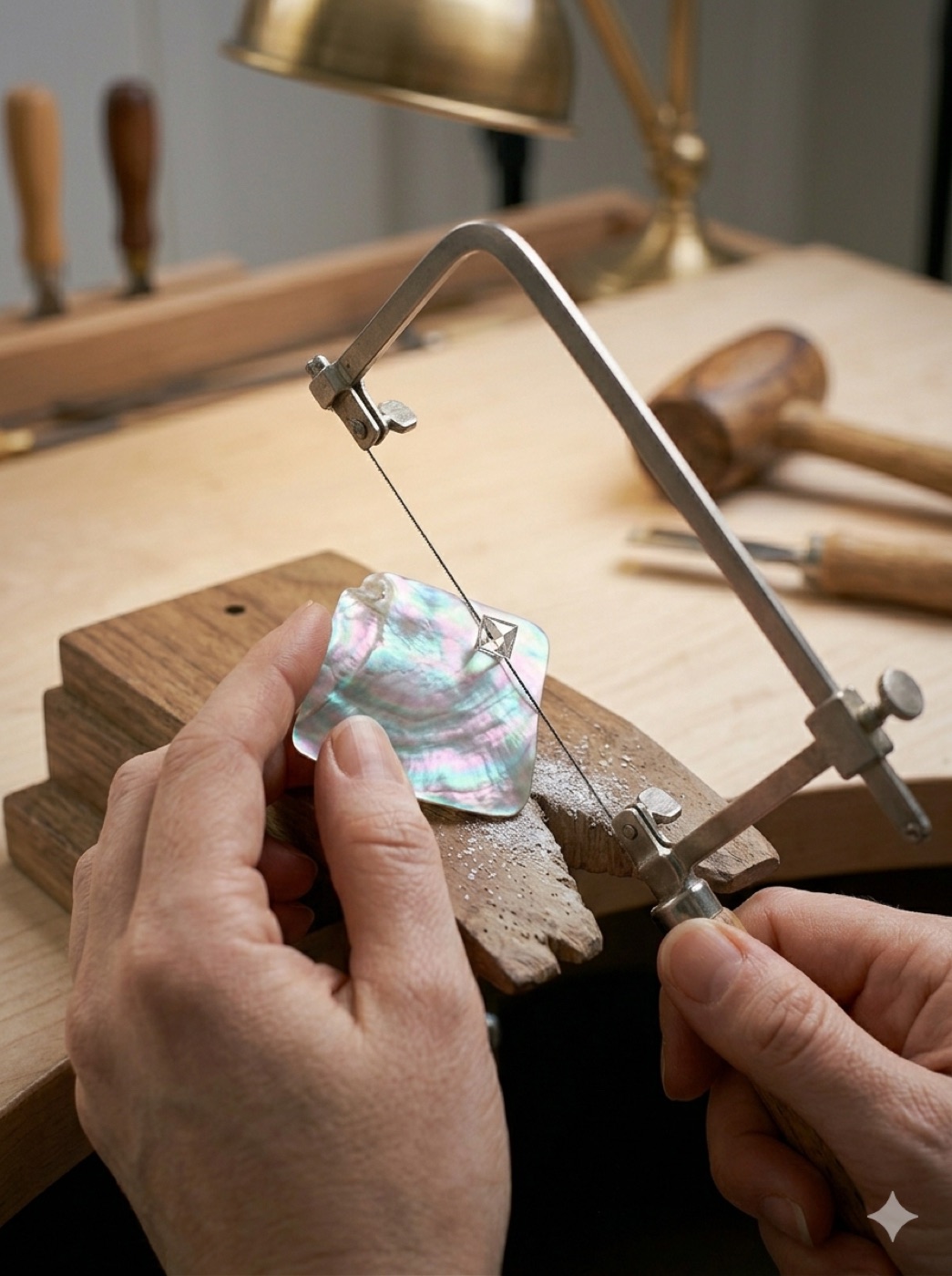
Mother-of-pearl shells from the Red Sea and Persian Gulf are hand-selected for their iridescence, thickness, and structural integrity. Using a jeweller's bow saw, the artisan cuts each fragment by eye — shaping thousands of pieces that will form the pattern.
A single cabinet may require over 15,000 individual pieces of shell, each cut to fit a specific cell. The artisan accounts for variations in shell thickness and colour to keep the finished surface harmonious.
Carving & Channel Work
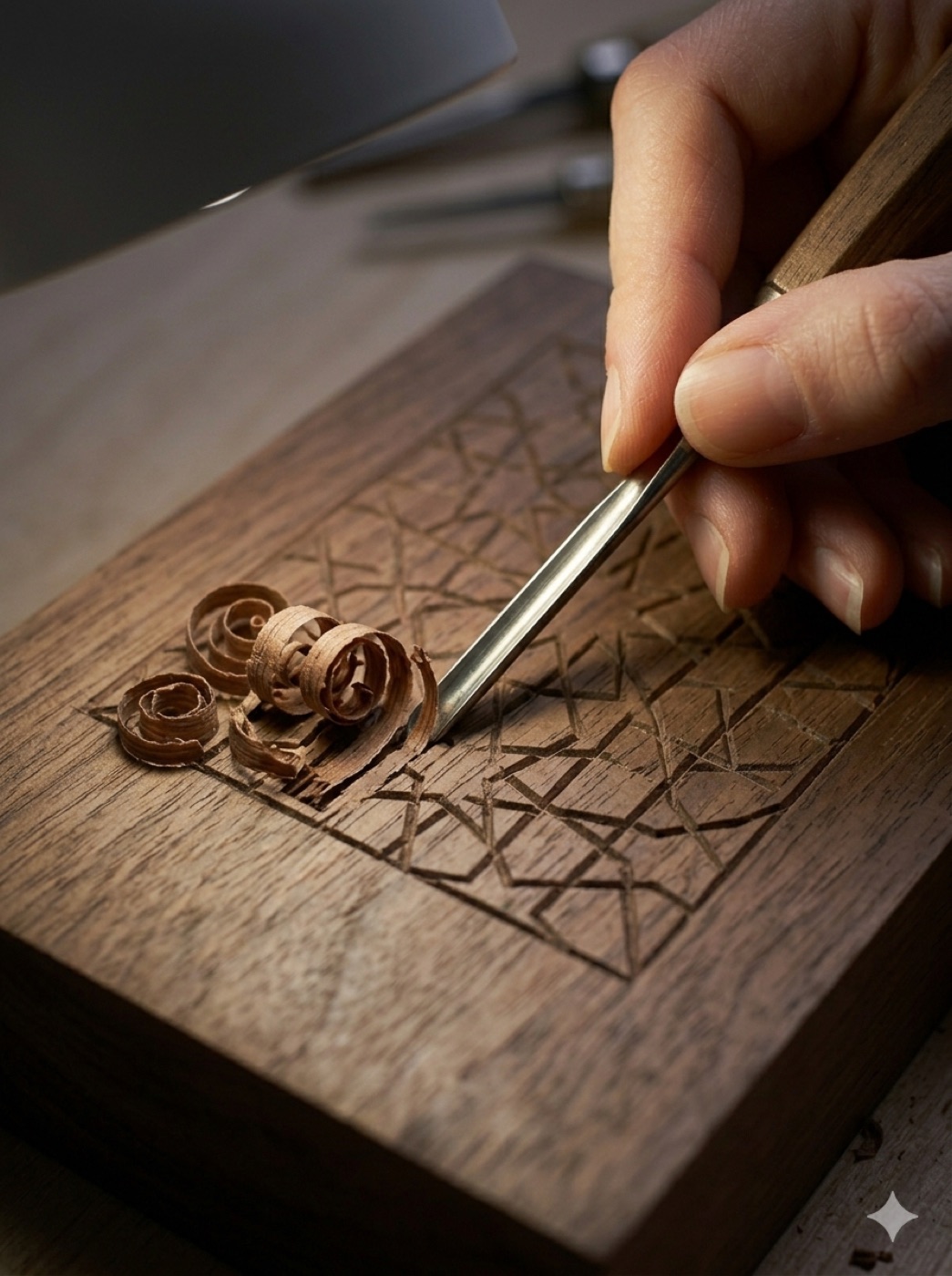
Using fine chisels and gouges, the artisan incises precise channels into the walnut. Each channel must be exactly the right depth and width to receive its corresponding piece of shell — a tolerance measured in fractions of a millimetre.
This is perhaps the most demanding stage. It requires absolute steadiness of hand and an intuitive understanding of how wood and shell will move together over decades as they expand and contract with the seasons.
Silver Wire Lining
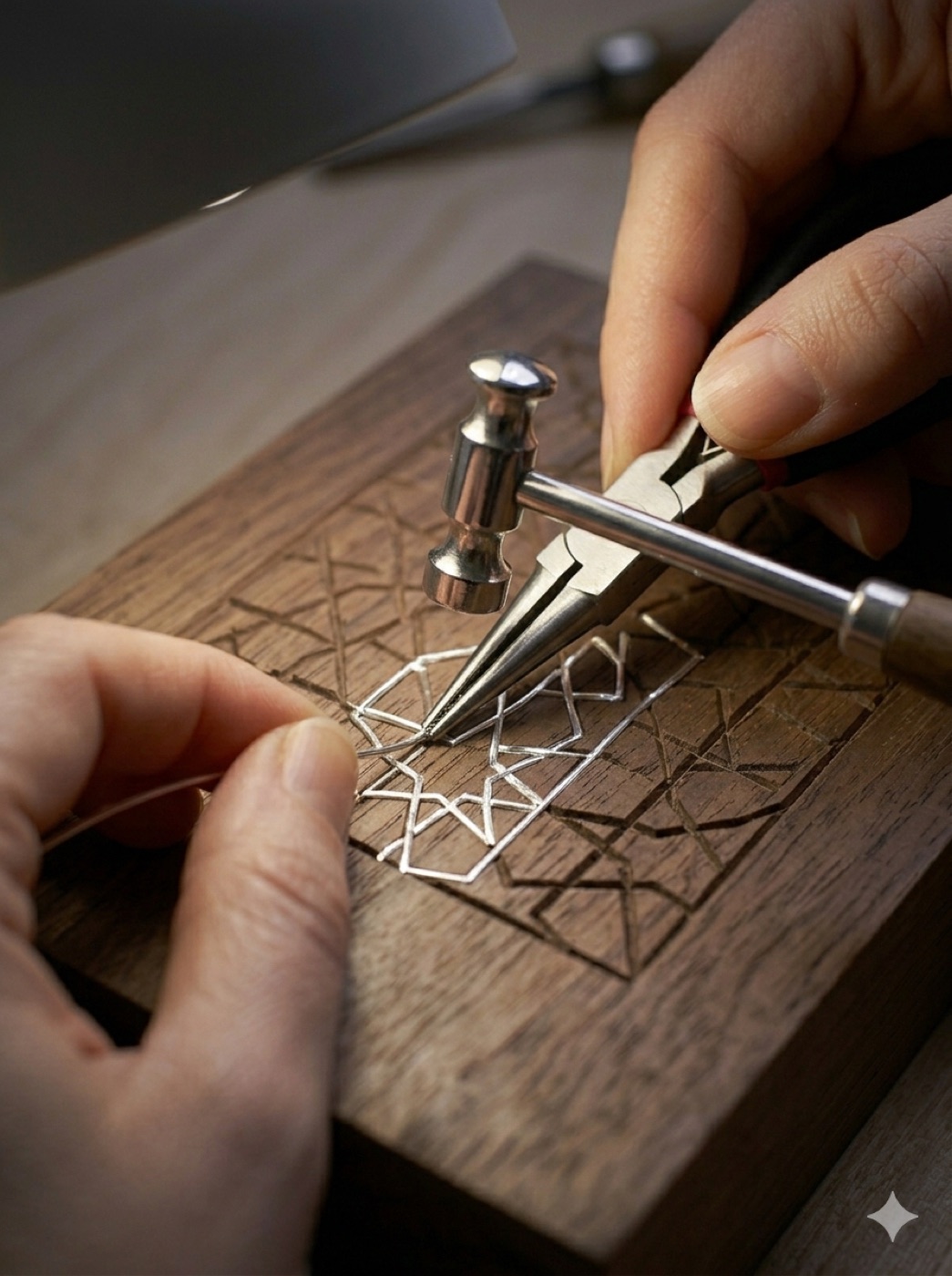
Thin silver wire is drawn through small jewellery pliers and bent, by hand, into the carved channels — defining the outline of every cell in the geometric pattern before any shell is set. This is what distinguishes the Damascene tradition from European marquetry.
The metal threads do two things at once: they lock the design's structure into the wood, and they catch light at angles the pearl cannot. The finished surface has two distinct kinds of shimmer playing against the dark walnut.
Inlay Setting
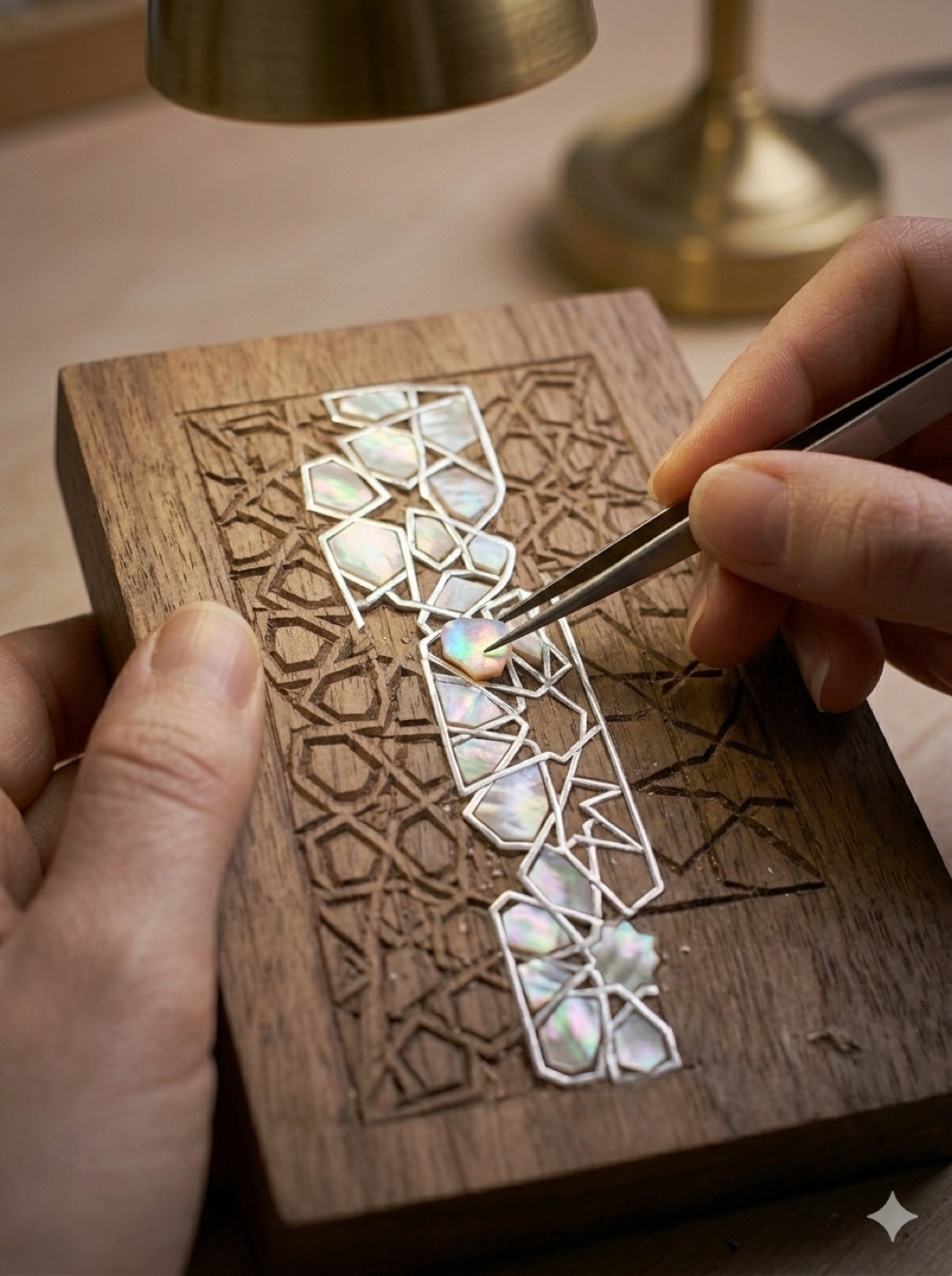
Each shell fragment is fitted into its silver-bordered cell with tweezers and a fine push tool, set with a traditional adhesive, and pressed flush with the surface. The artisan works section by section, checking alignment and visual harmony at every stage.
Setting alone may take weeks or months for a major piece. Every fragment must sit perfectly level with its neighbours and with the wood, creating a single seamless expanse of pattern.
Polishing & Finishing
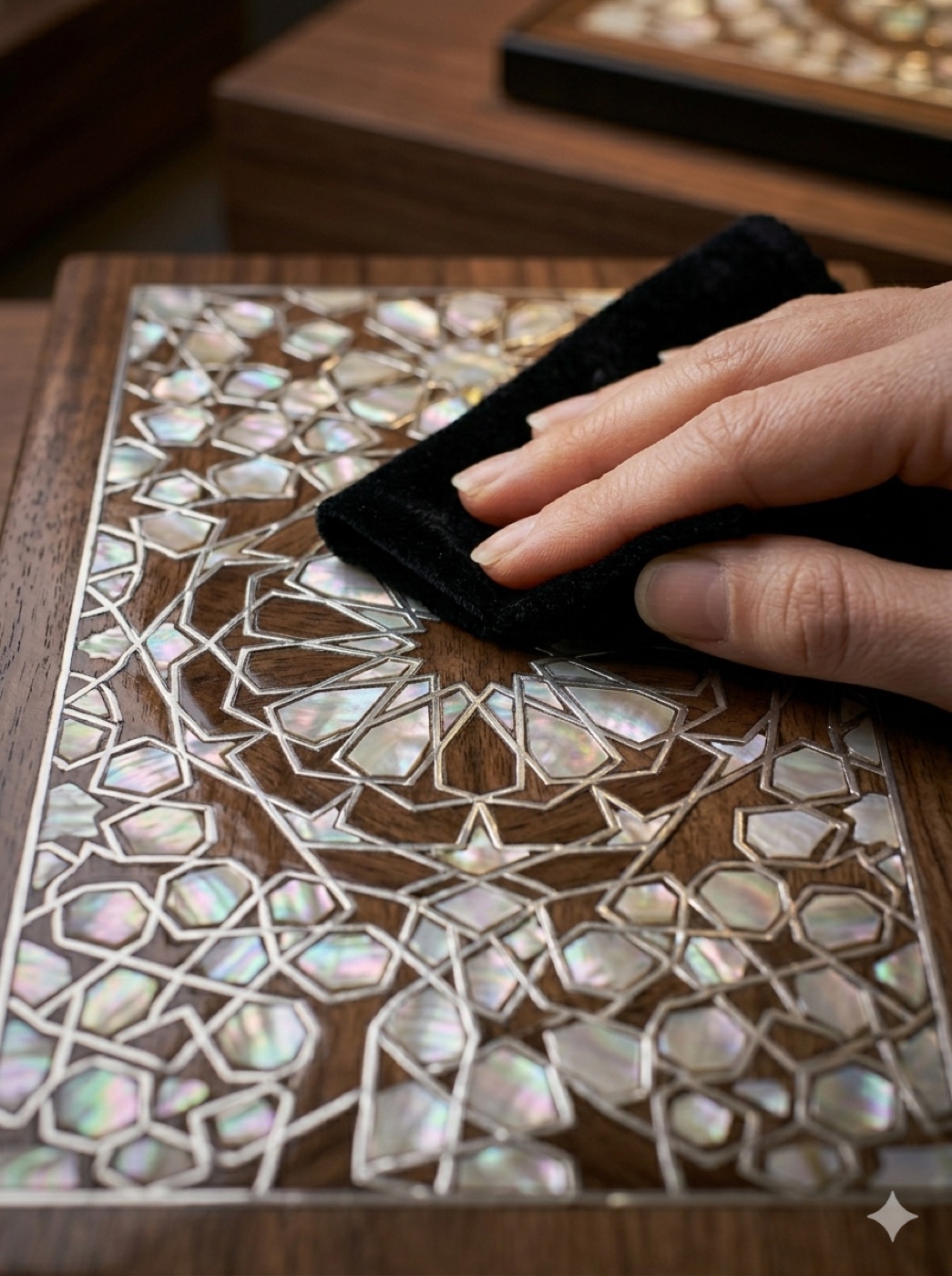
Successive rounds of hand sanding — from coarse to mirror-smooth — bring the surface to a glass-like finish. A natural wax dressing allows the mother-of-pearl to catch and refract light, producing the ethereal iridescence the work is known for.
The final polish is what transforms the piece from remarkable to alive. As light moves across the surface, each shell fragment, each silver thread, each grain in the walnut catches it differently — a slow, ever-shifting display.
Preservation & Restoration
Our expertise extends beyond new craftsmanship to the sensitive restoration and preservation of antique pieces. Using traditional techniques and materials, we bring treasured objects back to their original splendour while respecting their age and history.
Conservation
Stabilising and protecting pieces using museum-standard techniques that arrest deterioration without altering the original character.
Restoration
Sensitive repair using traditional materials and methods, matching original techniques to achieve seamless integration with surviving elements.
Authentication
Scholarly examination of construction, materials, and provenance to establish authenticity, period, and origin with confidence.
Experience the Craft
Visit our collection to see these extraordinary techniques embodied in museum-quality pieces available for acquisition.